Research Areas
Area 1: Atmosphere–Ocean-Wave coupled model Development
I have been working on the development of an atmosphere–ocean–wave coupled modeling system, designed to represent the interactions among the atmosphere, ocean, and surface waves. Technically, this work involved extensive model debugging, code verification, and systematic testing, through which I significantly strengthened my skills in numerical modeling and large-scale scientific code development. Scientifically, the process of building and coupling the model shaped my perspective on Earth system research, leading me to approach the atmosphere, ocean, and waves as interconnected components of a single, integrated system rather than isolated ones.
Area 2: Air–Sea Interactions in Hurricanes
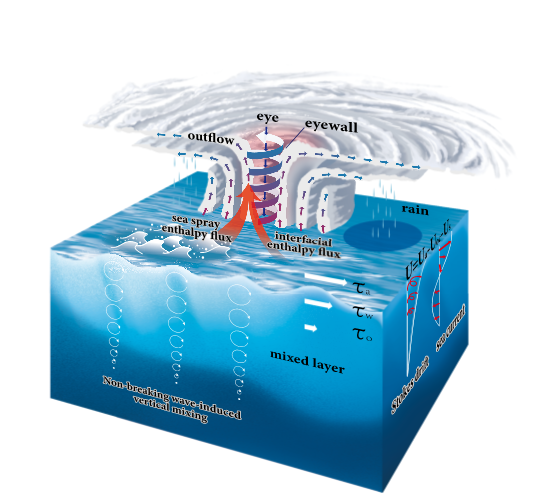
Despite substantial advances in numerical weather prediction, accurately forecasting tropical cyclone intensity remains a major challenge. This limitation is widely linked to deficiencies in current models, including insufficient resolution and an incomplete representation of air–sea interactions under extreme wind conditions. My research seeks to improve the representation of these processes by explicitly incorporating key air–sea–wave interaction mechanisms into coupled atmosphere–ocean–wave models. By representing these processes, this work contributes to more realistic simulations of tropical cyclone intensity. Through this research, I became more aware of how limited our current understanding remains of air–sea interactions under extreme conditions. The work highlighted that seemingly small-scale processes at the air–sea interface, when persistently misrepresented or neglected, can accumulate over time and lead to substantial differences in tropical cyclone intensity. This realization strengthened my appreciation of the need for physically grounded representations of air–sea exchange processes when studying and predicting extreme events.
Area 3: Ocean Surface Wave Dynamics in Offshore Energy Applications
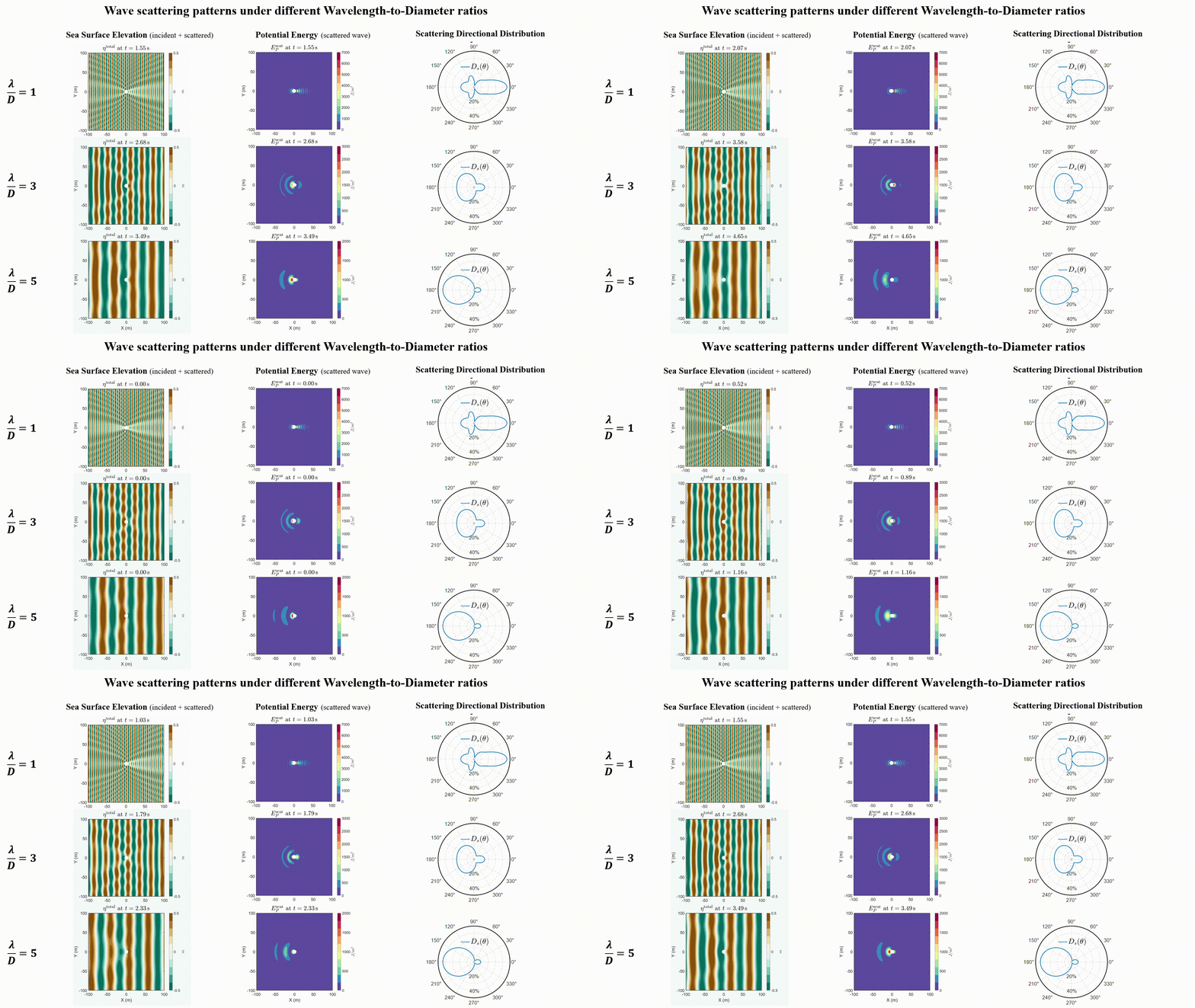
Offshore wind turbines and wave energy devices interact with ocean waves in complex ways, but these interactions are often treated in a highly simplified manner in spectral wave models. In this work, I developed a new parameterization based on classical wave theory to represent wave–structure interactions, in which total wave energy is conserved while being redistributed across wave directions to account for scattering by cylindrical structures. This method has been implemented in WAVEWATCH III as a source term. This project helped shape how I approach scientific problem. Rather than relying on empirical fixes, I learned to focus on the underlying physical principles and to build solutions directly from them.
Area 4: Air–Sea Coupled Processes and Their Impact on Extratropical Cyclone Predictability
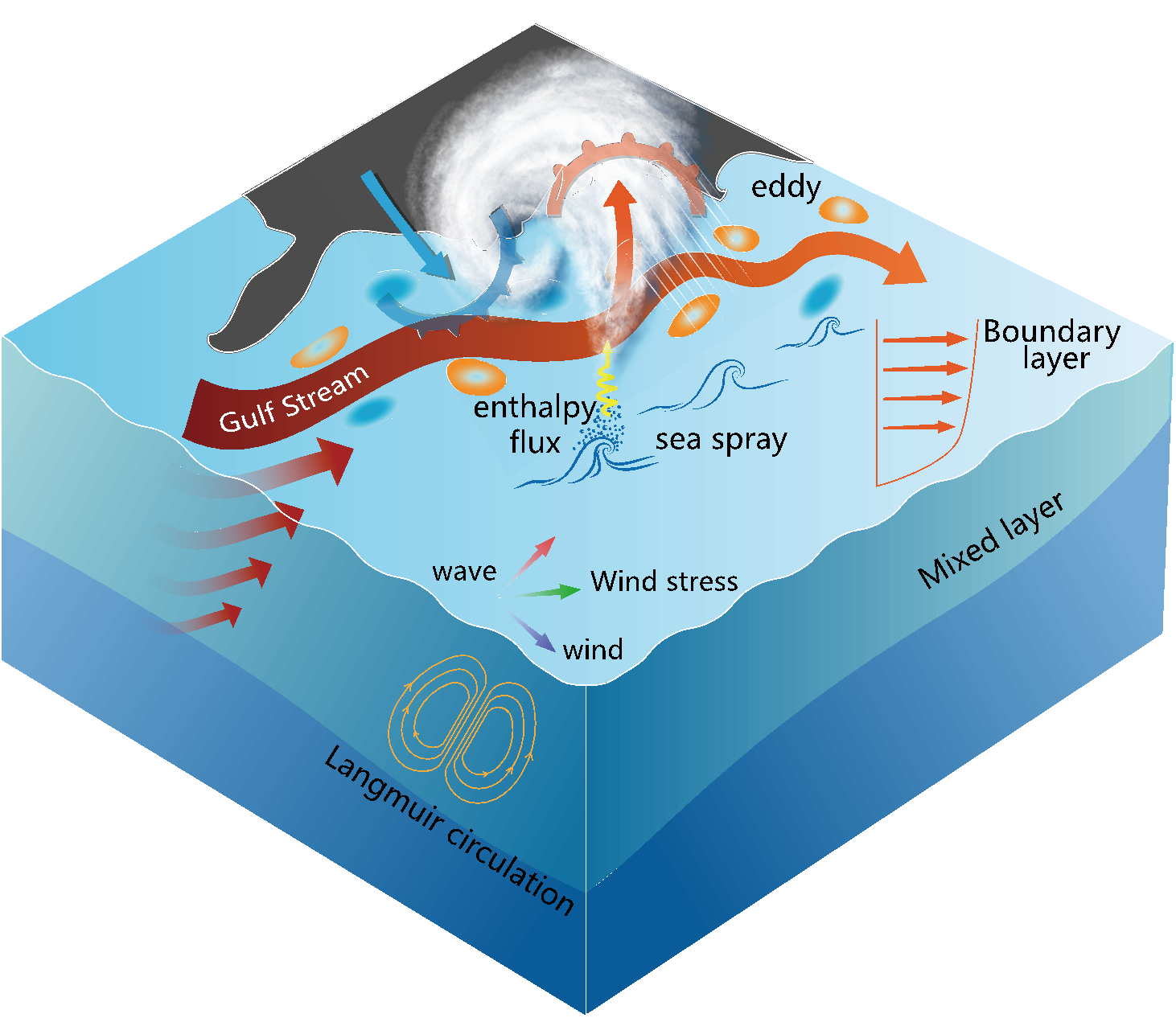
At Princeton University and NOAA GFDL, I am advancing the SHiELD-MOM6 atmosphere–ocean coupled modeling system by improving the physical representation of air–sea interactions. My research interests have further expanded to Nor’easters, a class of high-impact extratropical cyclones characterized by strong air–sea coupling that frequently affect the U.S. East Coast. These storms can produce extreme snowfall, strong winds, coastal flooding, and hazardous ocean waves. Using kilometer-scale coupled simulations, I investigate how air–sea processes influence storm evolution and their implications for enhancing the predictability of these events.